
Bandenbekämpfung
Intensification and naming a commissioner: italicize
| ← Previous revision | Revision as of 20:09, 23 April 2026 | ||
| Line 64: | Line 64: | ||
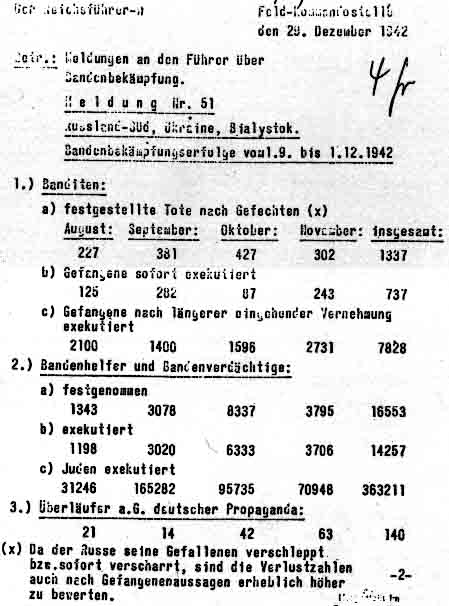
Also in October 1942—just a couple months prior to Gottberg's exploits—''[[Reichsmarschall]]'' [[Hermann Göring]] had ordered "anti-bandit warfare" in Army Group Rear Area Centre, which was shortly followed by an [[Oberkommando des Heeres|OKH]] Directive on 11 November 1942 for "anti-bandit warfare in the East" that announced sentimental considerations as "irresponsible" and instructed the men to shoot or preferably hang bandits, including women.{{sfn|Heer|2000|p=114}} Misgivings from commanders within Army Group Rear that such operations were counterproductive and in poor taste, since women and children were also being murdered, went ignored or resisted from Bach-Zelewski, who frequently "cited the special powers of the ''Reichsführer''."{{sfn|Heer|2000|p=115}} During late November 1942, forty-one "Polish-Jewish bandits" were killed in the forest area of Lubionia, which included "reprisals" against villages in the area.{{sfn|Blood|2006|pp=217}} Another action undertaken under the auspices of anti-bandit operations occurred near Lublin in early November 1943; named ''Aktion Erntefest'' (Action Harvest Festival), SS-Police, and ''Waffen-SS'' units, accompanied by members of the Lublin police, rounded up and killed 42,000 Jews.{{sfn|Blood|2006|pp=223–224}} |
Also in October 1942—just a couple months prior to Gottberg's exploits—''[[Reichsmarschall]]'' [[Hermann Göring]] had ordered "anti-bandit warfare" in Army Group Rear Area Centre, which was shortly followed by an [[Oberkommando des Heeres|OKH]] Directive on 11 November 1942 for "anti-bandit warfare in the East" that announced sentimental considerations as "irresponsible" and instructed the men to shoot or preferably hang bandits, including women.{{sfn|Heer|2000|p=114}} Misgivings from commanders within Army Group Rear that such operations were counterproductive and in poor taste, since women and children were also being murdered, went ignored or resisted from Bach-Zelewski, who frequently "cited the special powers of the ''Reichsführer''."{{sfn|Heer|2000|p=115}} During late November 1942, forty-one "Polish-Jewish bandits" were killed in the forest area of Lubionia, which included "reprisals" against villages in the area.{{sfn|Blood|2006|pp=217}} Another action undertaken under the auspices of anti-bandit operations occurred near Lublin in early November 1943; named ''Aktion Erntefest'' (Action Harvest Festival), SS-Police, and ''Waffen-SS'' units, accompanied by members of the Lublin police, rounded up and killed 42,000 Jews.{{sfn|Blood|2006|pp=223–224}} |
||
Large-scale operations (''Grossunternehmen'') during 1942–1943 operated under the rhetorical cover of military necessity while functioning in practice as campaigns of plunder and mass murder.{{sfn|Richter|2014|pp=220–221}} Bach-Zelewski's February 1943 guidelines made the economic calculus explicit; he remarked that "every ton of grain, every cow, every horse is worth more than a shot bandit."{{sfn|Richter|2014|p=221}} Agronomists embedded in the battle groups oversaw requisitions, while often determining which villages survived and which were destroyed. The threshold for destruction was quite low as entire villages were wiped out if deemed "gang-friendly" (bandenfreundlich), a designation requiring no evidentiary standard.{{sfn|Richter|2014|p=221}} Paranoia led to increasingly irrational orders being issued; such proved the case when after coming upon a partisan camp with a large number of bicycles, the commander of the 1st SS Infantry Brigade, Karl von Treuenfeld, directed that "anybody bicycling has to be shot."{{sfn|Richter|2014|p=221}} |
Large-scale operations (''Grossunternehmen'') during 1942–1943 operated under the rhetorical cover of military necessity while functioning in practice as campaigns of plunder and mass murder.{{sfn|Richter|2014|pp=220–221}} Bach-Zelewski's February 1943 guidelines made the economic calculus explicit; he remarked that "every ton of grain, every cow, every horse is worth more than a shot bandit."{{sfn|Richter|2014|p=221}} Agronomists embedded in the battle groups oversaw requisitions, while often determining which villages survived and which were destroyed. The threshold for destruction was quite low as entire villages were wiped out if deemed "gang-friendly" (''bandenfreundlich''), a designation requiring no evidentiary standard.{{sfn|Richter|2014|p=221}} Paranoia led to increasingly irrational orders being issued; such proved the case when after coming upon a partisan camp with a large number of bicycles, the commander of the 1st SS Infantry Brigade, Karl von Treuenfeld, directed that "anybody bicycling has to be shot."{{sfn|Richter|2014|p=221}} |
||
Over time, the ''Wehrmacht'' acculturated to the large scale anti-bandit operations, as they too came to see the entire population as criminal and complicit in any operation against German troops. Many German Army commanders were unbothered by the fact that these operations fell under the jurisdiction of the SS.{{sfn|Heer|2000|pp=118–119}} Historians [[Ben H. Shepherd|Ben Shepherd]] and Juliette Pattinson note: |
Over time, the ''Wehrmacht'' acculturated to the large scale anti-bandit operations, as they too came to see the entire population as criminal and complicit in any operation against German troops. Many German Army commanders were unbothered by the fact that these operations fell under the jurisdiction of the SS.{{sfn|Heer|2000|pp=118–119}} Historians [[Ben H. Shepherd|Ben Shepherd]] and Juliette Pattinson note: |
||














